
Why Hydraulic Reservoir Size Matters: A Sizing Guide
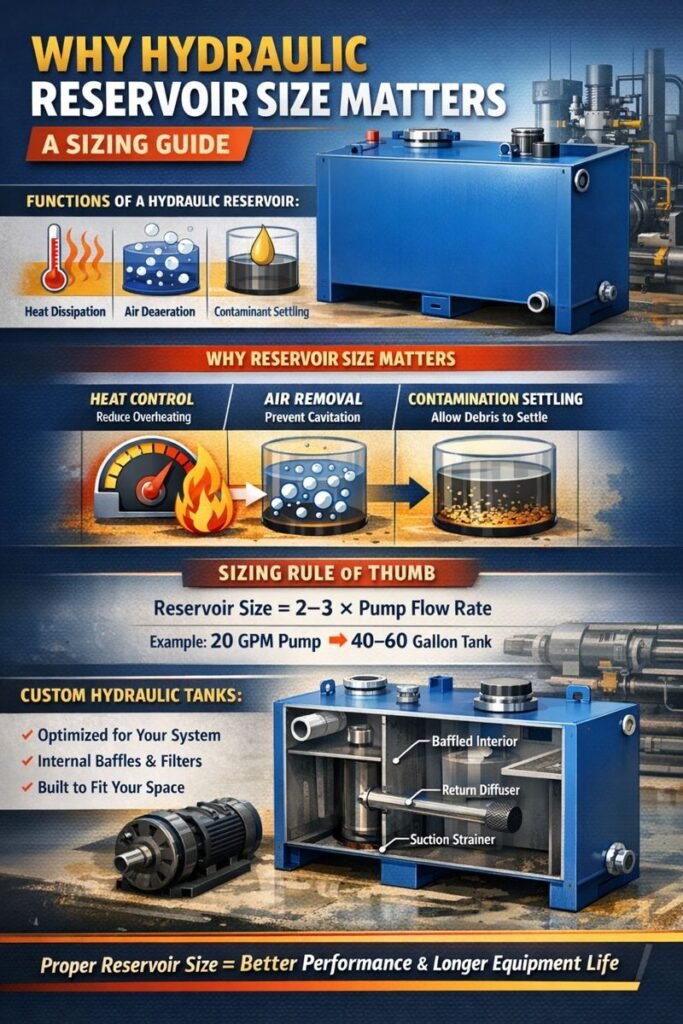
When you’re sizing a hydraulic reservoir, you’re not just picking a container for oil. You’re deciding how forgiving the system is going to be when things aren’t perfect — and they’re never perfect in the real world.
In the shop, we see a lot of systems that technically “work” on paper, but in the field they run hot, aerate the oil, or eat pumps. Most of the time, it traces back to a tank that was sized to a rule of thumb instead of how the machine actually runs.
What happens when the tank is too small
Small tanks look good on drawings. They save space, cost less, and ship easier. Then they get bolted into a machine and all the problems show up.
With a small reservoir, return oil doesn’t get much time to settle. Air stays mixed in. You get foam in the sight glass. The pump starts pulling aerated oil and you hear that gravel sound. That’s not a pump defect — that’s the tank not giving the oil time to calm down.
We also see heat buildup. The oil just keeps cycling through with no dwell time. No surface area, no cooling, no chance to dump heat. Then guys start adding coolers to fix what should’ve been handled with more oil volume and better internal layout.
From a fabrication side, small tanks also mean tight internal clearances. Baffles end up too close. Suction is right next to return. That’s a bad layout but it happens when someone forces a tank to be smaller than it should be.
What happens when the tank is too big
Oversizing isn’t free either. Big tanks take up floor space. They add weight. On mobile equipment, that matters. On trucks, it changes axle loading. We’ve had customers oversize tanks and then fight mounting issues because the frame rail space just isn’t there.
Big tanks also get lazy oil. If the flow pattern is bad, you can end up with dead zones. Sludge settles and stays there. When you drain for service, you don’t get everything out. Then fresh oil goes back in on top of junk that never moved.
From a build standpoint, bigger tanks mean thicker material or more bracing if you want them to survive vibration. Long flat panels will oil-can and crack if you don’t reinforce them. That’s more welding, more distortion control, more chances to warp ports out of square.
Real-world sizing isn’t just gallons
Flow rate matters, but so does duty cycle. A machine that runs 8 hours steady is different than one that spikes flow for 30 seconds and then sits.
We ask customers how the machine is actually used. Continuous run? Intermittent? High return flow? Case drain? Multiple pumps dumping back into one tank? That changes how much dwell time you really get.
Oil type matters too. Thicker oil holds heat longer and releases air slower. Thin oil cools easier but can foam if return velocity is wrong.
Ambient conditions matter more than people think. A tank that’s fine in a 60°F shop can overheat in a hot enclosure or on equipment sitting in the sun.
Internal layout is just as important as size
We cut open a lot of competitor tanks. Same gallon rating, totally different behavior.
If return dumps right on top of suction, size doesn’t save you. If baffles are too short or welded crooked, oil shortcuts across. If the suction port is too high, you’ll suck air before the tank is actually empty.
In our builds, we pay attention to:
Return side vs suction side separation
Baffle height and weld sealing
Suction port elevation off the floor
Clean-out access for sludge
Real breather sizing (not the cheapest one)
Those details matter more than adding 5 extra gallons.
Service and maintenance reality
Bigger tanks mean more oil to buy. That’s real money for fleet customers. It also means longer warm-up times in cold weather.
Smaller tanks mean more frequent oil changes and more filter plugging if contamination stays suspended.
We’ve seen customers regret both directions depending on how they actually maintain equipment. If nobody drains and cleans tanks, oversized can turn into a sludge box. If they run hard and never monitor temp, undersized will cook oil fast.
Custom tanks vs off-the-shelf
Off-the-shelf tanks are built to hit a price and fit “most” machines. That’s fine for simple systems.
When space is tight, flow is high, or mounting is weird, custom makes more sense. We can move ports, add real baffles, thicken mounting pads, and design for how it actually bolts to your frame.
It’s not about fancy. It’s about not cutting corners that cause downtime later.
Buyer advice from the shop floor
If you’re deciding on reservoir size:
Don’t size to catalog rules only
Look at how long oil actually stays in the tank
Check where return and suction really land
Think about heat before adding a cooler
Think about mounting and vibration early
Most hydraulic problems blamed on pumps or valves start with tank design. Not dramatic failures — slow killers like heat, air, and dirt.
reservoir that’s too small can cause overheating, foaming/aeration, and pump cavitation because the oil doesn’t have enough time to cool, release air, or let contamination settle. This often leads to shorter component life and more downtime.
common starting point is:
Reservoir volume = 2–3 × pump flow rate (GPM)
Example: 20 GPM → 40–60 gallon reservoir
Final sizing should also consider duty cycle, heat load, cylinder volume, and available cooling.
Not always. Bigger can improve cooling and deaeration, but it can also increase cost, space needs, and warm-up time. The best reservoir is the one sized and designed for your operating conditions.
Mobile systems often need smarter design because space is limited and airflow may be poor. You may need a custom-shaped reservoir, proper baffles/diffusers, and sometimes a cooler to maintain temperature and prevent aeration.
Baffles slow and direct return flow to reduce turbulence. This improves air separation, helps contaminants settle, and reduces the chance of the pump pulling aerated oil.
Choose custom when you need specific dimensions, port locations, mounting, or internal features like baffles, diffusers, suction strainers, or return filtration. Custom tanks can improve performance even when total volume stays similar.