
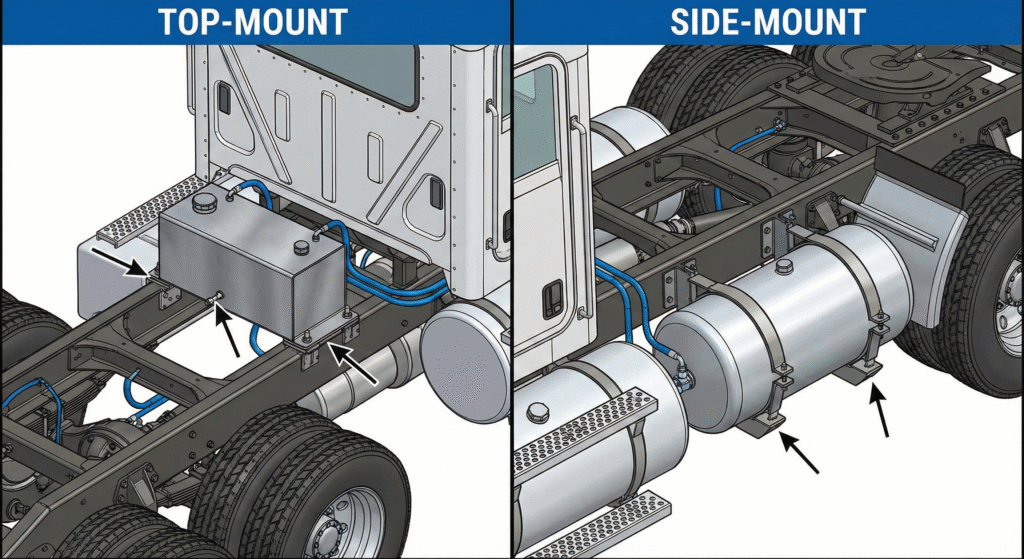
When designing a hydraulic system, one of the critical decisions you’ll face is choosing between a top-mount hydraulic tank and a side-mount hydraulic tank configuration.
While this might seem like a minor detail, the mounting style of your hydraulic reservoir tank can significantly impact your system’s performance, maintenance requirements, and overall efficiency. Whether you’re selecting a steel hydraulic tank or an aluminum hydraulic reservoir, understanding these differences is crucial. Let’s dive into the key differences to help you make the right choice for your application.
Understanding the Basics
The question "Top-Mount vs Side-Mount Hydraulic Tanks — Which is Better?" is one of the most common debates among hydraulic system designers and engineers. Before we compare the two, let's clarify what we're talking about.
A hydraulic tank (also called a hydraulic reservoir tank) stores hydraulic fluid and serves several essential functions: heat dissipation, air separation, contaminant settling, and fluid storage.
These tanks come in various sizes—from compact 7 gallon hydraulic tank units for small machinery to larger 30 gallon hydraulic tank, 50 gallon hydraulic reservoir, and even bigger configurations for industrial applications. The mounting style refers to how pumps, motors, and other components attach to the reservoir.
- Top-mount reservoirs feature mounting surfaces on the top of the tank, where pumps and motors bolt directly to the reservoir lid or top plate. A top-mount hydraulic tank is popular in stationary industrial applications.
- Side-mount reservoirs have mounting provisions on the side walls, allowing components to be attached vertically along the tank’s exterior. A side-mount hydraulic tank is commonly used in mobile equipment and truck applications.
Top-Mount Hydraulic Tanks: Advantages and Considerations
- Advantages
Compact Footprint: Top-mount configurations shine in applications where floor space is at a premium. By stacking components vertically, you minimize the hydraulic power unit’s horizontal footprint. This makes them ideal for facilities with limited space.
Improved Suction Characteristics: With pumps mounted above the fluid level, gravity assists in feeding fluid to the pump inlet, reducing cavitation risk and improving pump longevity. This positive head pressure is especially beneficial for systems operating in demanding conditions. Many units come equipped with a hydraulic tank and a sight gauge to monitor fluid levels easily.
Easier Air Separation: The vertical orientation naturally encourages air bubbles to rise and separate from the hydraulic fluid before entering the pump, leading to more consistent system performance.
Simplified Design: Top-mount systems often result in shorter suction lines and fewer fittings, reducing potential leak points and pressure drops. Modern designs frequently include a hydraulic tank with a return filter and a breather cap to improve fluid cleanliness.
- Considerations
Height Restrictions: The primary limitation is vertical clearance. Top-mount systems are taller, which can be problematic in facilities with low ceilings or when the unit needs to fit beneath equipment.
Maintenance Access: Servicing pumps or motors mounted on top may require ladders or platforms, potentially complicating routine maintenance tasks.
Weight Distribution: All major components rest on top of the reservoir, which can affect stability and may require reinforced tank construction.
Side-Mount Hydraulic Tanks: Advantages and Considerations
- Advantages
Lower Profile: Side-mount configurations keep the overall height down, making them ideal for applications with vertical space constraints or where a low center of gravity is desired.
Easier Access: Components mounted on the sides are typically easier to inspect, maintain, and repair. Technicians can work on the system without climbing or using special equipment.
Flexible Component Arrangement: Side mounting allows positioning multiple pumps or motors along the tank perimeter, which can be advantageous in complex systems.
Better for Mobile Applications: The lower center of gravity makes side-mount systems particularly suitable for mobile equipment where stability during movement is crucial. This includes dump truck hydraulic tank applications, semi truck hydraulic reservoir systems, and wet kit reservoir tank configurations for commercial vehicles. An aluminum hydraulic reservoir is often preferred in these applications due to its lighter weight compared to a steel hydraulic tank.
- Considerations
Larger Footprint: Side-mount systems require more floor space since components extend horizontally from the tank.
Suction Line Complexity: Depending on the fluid level and pump position, you may need longer suction lines or additional fittings, which can introduce potential leak points and pressure losses.
Potential Cavitation Issues: If the pump centerline is positioned above the fluid level, you may need to carefully design the suction system to prevent cavitation, especially during startup or low-fluid conditions.
Key Selection Factors
When evaluating “Top-Mount vs Side-Mount Hydraulic Tanks — Which is Better?” for your specific needs, consider these critical factors:
Space Constraints: Measure your available space carefully. Do you have limited floor space but adequate height, or vice versa?
Accessibility Requirements: How frequently will the system need maintenance? Who will perform it, and what tools will they have available?
Application Type: Is this a stationary industrial system or mobile equipment? Stationary systems often favor top-mount for space efficiency, while mobile applications like dump trucks and semi trucks typically benefit from side-mount stability.
Fluid Volume Requirements: Larger reservoirs may be better suited to side-mount configurations to maintain reasonable overall dimensions and stability. Consider whether you need a compact 7-gallon hydraulic tank, a mid-sized 30-gallon hydraulic tank, or a larger 50-gallon hydraulic reservoir based on your system’s flow requirements and cycle times.
Material Selection: Decide between a steel hydraulic tank for maximum durability and strength, or an aluminum hydraulic reservoir for weight savings in mobile applications. Steel tanks are typically more cost-effective and better for high-temperature applications, while aluminum offers corrosion resistance and reduced weight.
System Pressure and Flow: High-flow systems particularly benefit from the positive suction head provided by top-mount configurations.
Budget Considerations: Top-mount systems may offer cost savings through simpler plumbing and fewer components, though this varies by application.
The Verdict: Top-Mount vs Side-Mount Hydraulic Tanks — Which is Better?
The truth is, neither mounting style is universally “better”—the right choice depends entirely on your specific application requirements. The answer to “Top-Mount vs Side-Mount Hydraulic Tanks — Which is Better?” varies based on your unique situation.
Choose top-mount if you need to maximize floor space, want optimal pump suction conditions, and have adequate vertical clearance. This configuration excels in stationary industrial applications where efficiency and compact horizontal dimensions are priorities.
Choose side-mount if you’re working with height restrictions, prioritize easy maintenance access, or need a lower center of gravity for stability. This style works well for mobile equipment such as dump truck hydraulic tank systems, semi-truck hydraulic reservoir installations, and wet kit reservoir tank setups, where stability during vehicle operation is critical.
Essential Features to Consider
Regardless of which mounting style you choose, look for these essential features in your hydraulic tank:
Hydraulic Tank with Sight Gauge: This allows operators to quickly check fluid levels without opening the tank, reducing contamination risk and simplifying daily inspections.
Hydraulic Tank with Return Filter: Return-line filtration removes contaminants before the fluid re-enters the reservoir, significantly extending component life and maintaining system cleanliness.
Hydraulic Tank with Breather Cap: A proper breather cap with filtration prevents airborne contaminants from entering while allowing the tank to breathe as fluid levels change during operation.
These features are available in both steel hydraulic tank and aluminum hydraulic reservoir configurations, across all standard sizes from 7 gallons to 50 gallons and beyond.
In many cases, the decision comes down to the physical constraints of your installation site. Before committing to either option, carefully assess your space, maintenance procedures, and operational requirements. Consulting with a hydraulic systems engineer can help ensure you select the configuration that will deliver the best long-term performance and value for your specific application.
Remember, a well-designed hydraulic system—regardless of mounting style—will incorporate proper filtration, cooling, and fluid management practices. The mounting configuration is just one piece of the puzzle in creating an efficient, reliable hydraulic power system.
The main difference lies in where components attach to the reservoir. Top-mount hydraulic tanks have pumps and motors mounted on the top surface, creating a vertical configuration. Side-mount hydraulic tanks have components attached to the side walls, resulting in a lower profile but wider footprint.
Side-mount hydraulic tanks are generally better for mobile applications, such as dump truck hydraulic tank systems and semi truck hydraulic reservoir installations. The lower center of gravity provides better stability during vehicle operation and movement. Many mobile applications also use aluminum hydraulic reservoir construction to reduce overall weight.
The size depends on your system’s flow rate and cycle time. As a general rule, the tank should hold 3-5 times the pump’s flow rate per minute. Common sizes include 7 7-gallon hydraulic tank for compact equipment, 30 30-gallon hydraulic tank for medium-duty applications, and 50 50-gallon hydraulic reservoir for larger industrial systems. Consult with a hydraulic engineer to determine the optimal size for your specific needs.
Steel hydraulic tanks are typically more durable, cost-effective, and better suited for high-temperature applications and stationary systems. Aluminum hydraulic reservoirs are lighter, offer excellent corrosion resistance, and are preferred for mobile applications where weight reduction is critical, such as wet kit reservoir tank systems for commercial trucks.
Yes, a hydraulic tank with a return filter is highly recommended for most applications. Return line filtration removes contaminants before fluid re-enters the reservoir, significantly extending the life of pumps, valves, cylinders, and other system components. It’s one of the most effective ways to maintain system cleanliness and reliability.
A hydraulic tank with a breather cap allows air to enter and exit the reservoir as fluid levels change during operation, preventing vacuum or pressure buildup. Quality breather caps include filtration elements that prevent airborne contaminants, dust, and moisture from entering the system, which is essential for maintaining fluid cleanliness.