
Semi Truck Fuel Tank Capacity: What Fleet Owners and Fabricators Actually Need to Know
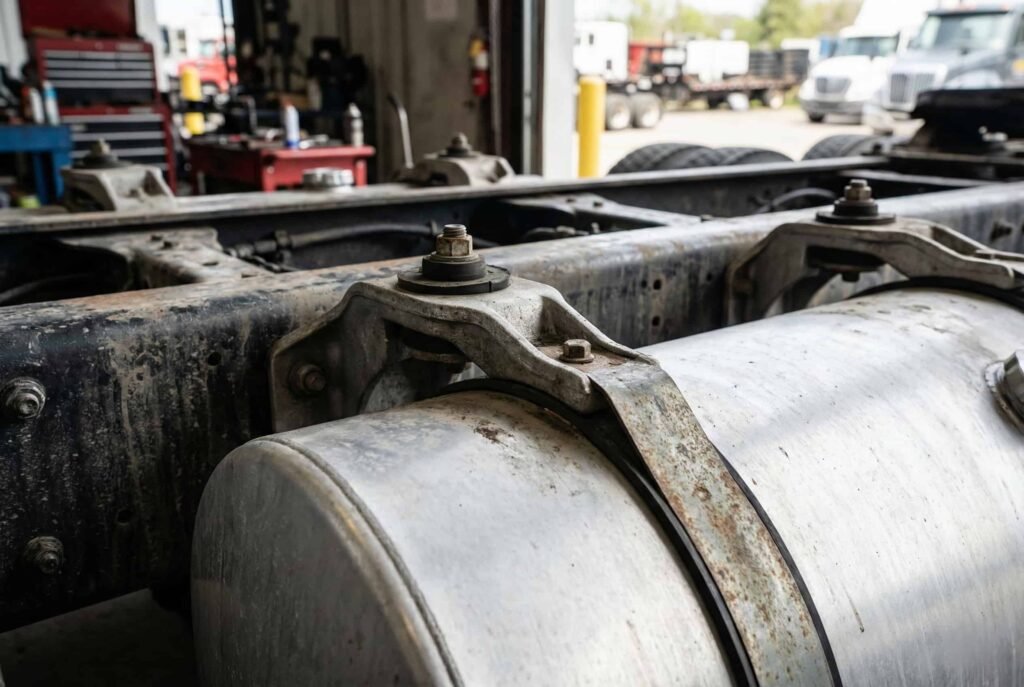
If you’re Googling semi truck fuel tank capacity, you’re probably not just curious about numbers. You’ve got a specific truck, a specific route, and a real problem — whether that’s a damaged tank, a range limitation, or a custom build that needs a non-stock solution.
This guide gives you the real capacity numbers, the weight math that matters, and what to think about when stock tanks don’t cut it anymore.
Real Semi Truck Fuel Tank Capacity (Not Textbook Guesses)
Most highway tractors run dual side-mounted diesel tanks. Here’s what you’ll actually see in the field:
- 100–150 gallons per tank
- 200–300 gallons total capacity on standard setups
- Long-haul configurations sometimes exceed 300 gallons combined
But here’s the detail most guides skip over: drivers don’t fill to 100%.
Standard practice is stopping at 90–95% full — not because drivers are being conservative, but because diesel expands with heat, sloshes on grades, and needs vent room. A “300-gallon system” in practice carries closer to 270 usable gallons.
That gap matters the moment you’re calculating range, payload compliance, or figuring out whether a replacement tank needs to be larger than the OEM spec.
Why Tank Size Isn’t Just About Space
From a fabrication standpoint, semi truck fuel tank capacity is constrained by a lot more than available frame room. These are the real limits that drive custom tank decisions.
Frame Rail Clearance
Between battery boxes, DEF tanks, air tanks, tool storage, and aftertreatment components, usable straight rail for a cylinder tank gets eaten up fast. This is the same packaging problem we solve constantly in hydraulic reservoir design — steel space always wins the argument. When a replacement or auxiliary tank needs to fit a specific truck configuration, off-the-shelf dimensions almost never work cleanly.
DOT Weight Limits
Diesel runs about 7 pounds per gallon. At 300 gallons, that’s 2,100 pounds of fuel before you touch freight.
Fleets are constantly balancing:
- Range between stops
- Legal payload weight
- Axle distribution across the frame
Adding capacity without running the weight math first is how you end up with a DOT violation on a loaded run. Any auxiliary tank design has to account for this upfront — not after the tank is already welded on.
Real-World Range vs. Brochure Math
On paper, a long-haul truck averaging 6–8 MPG with 250 usable gallons should get 1,500–2,000 miles per fill. In reality, idling, terrain, headwinds, traffic, and driver behavior consistently cut that number down.
Fleet managers who’ve done this long enough stop trusting highway MPG estimates and plan for real-world figures 15–25% lower than spec.
When Stock Tanks Stop Working
Most semi truck fuel tank replacements or auxiliary installs fall into a few specific situations. If any of these sound familiar, you’re probably past the point where a stock part solves it.
Tank damage from road debris or collision. OEM replacement tanks are available but often back-ordered, don’t fit modified frames, or aren’t built for the service environment the truck actually runs in. A steel fabricated replacement can be built to match the exact mounting points and capacity you need.
Extended range requirements. If your routes push past what dual stock tanks cover reliably, an auxiliary tank is the practical answer. The key is doing it right — improper plumbing causes fuel starvation, weight imbalance, and venting failures that create bigger problems than the range issue you started with.
Specialty or vocational applications. Off-road equipment, construction trucks, and work trucks running in severe-duty environments often need tanks built for those conditions — not for a highway tractor spec.
Steel vs. Aluminum: The Fabrication Trade-Off
Both materials show up in the field. Here’s how the actual trade-off breaks down:
Aluminum Tanks
- Lighter — meaningful on payload-sensitive runs
- Corrosion-resistant without coating
- Common on highway tractors from OEM
The downside: aluminum dents easier, cracks at mounts over time under vibration, and is harder to repair cleanly in the field. If a tank takes impact damage, you’re often looking at replacement rather than repair.
Steel Tanks
- Stronger under impact and in severe-duty environments
- Weld-repairable in the field
- Better for off-road, construction, or high-vibration applications
Steel needs proper coating to prevent corrosion, and it adds weight — but for equipment that actually takes abuse, it holds up longer and costs less over its service life.
This same trade-off comes up in every hydraulic reservoir build we do. Material choice isn’t about preference — it’s about what the operating environment actually demands.
Common Fuel System Problems That Aren’t About Tank Size
Most fuel system failures on semi trucks don’t start with capacity. They start with installation or maintenance shortcuts that create flow problems.
The ones we see most often:
- Blocked tank vents creating vacuum that starves fuel flow
- Pickup tube height set wrong, causing starvation on grades or low fuel
- Contamination from poor maintenance or improper auxiliary tank integration
- Weight imbalance after adding auxiliary capacity without recalculating axle distribution
- Improper crossover plumbing between dual tanks causing uneven draw
Fluid systems don’t forgive shortcuts. The same failure patterns show up in hydraulic reservoirs that were installed without proper attention to suction head, venting, and return line placement.
How This Connects to Hydraulic Reservoir Design
Truck fuel tanks and hydraulic reservoirs are solving the same core engineering problems — fluid expansion, suction head pressure, contamination control, mounting stress, and thermal movement.
The difference is precision. Hydraulic reservoirs have to manage return oil aeration, heat dissipation, internal baffling, and pump protection at the same time. A catalog part built to generic dimensions won’t do that reliably in a real equipment application.
That’s why fabrication experience with fuel tank systems translates directly to hydraulic reservoir work — the physics are the same, the tolerances are just tighter.
Semi Truck Fuel Tank Capacity Calculator
Enter your tank sizes and assumptions to estimate total capacity, usable gallons, fuel weight, and range.
Steel tanks, real mounting constraints, real shop welds.
Most semi trucks carry 200 to 300 gallons total using dual tanks, though usable fuel is slightly lower due to expansion space.
Depending on MPG and load, many long-haul trucks travel 1,200 to 2,000 miles per fill-up in real conditions.
Diesel expands with heat and movement. Leaving 5–10% air space prevents overflow and pressure issues.
Aluminum is lighter and corrosion-resistant, while steel is stronger and easier to repair. The best choice depends on duty environment.
Yes, but improper installation can cause weight imbalance, plumbing issues, or fuel starvation, so design matters.