
2–3 Gallon Hydraulic Reservoir Tanks
If you’re searching for a 2 gallon hydraulic reservoir tank or a small hydraulic reservoir tank, it usually means one of two things:
either space is tight, or the original tank already failed and you don’t want to repeat that mistake.
We build 2–3 gallon hydraulic reservoir tanks for equipment that vibrates, flexes, and runs hotter than the catalog designs assume. Most of these are replacement tanks for mobile units, lifts, dump trailers, and compact machines where the original oil reservoir cracked, overheated, or pulled air.
Small tanks don’t fail because they’re small. They fail because they’re built and mounted like big tanks.
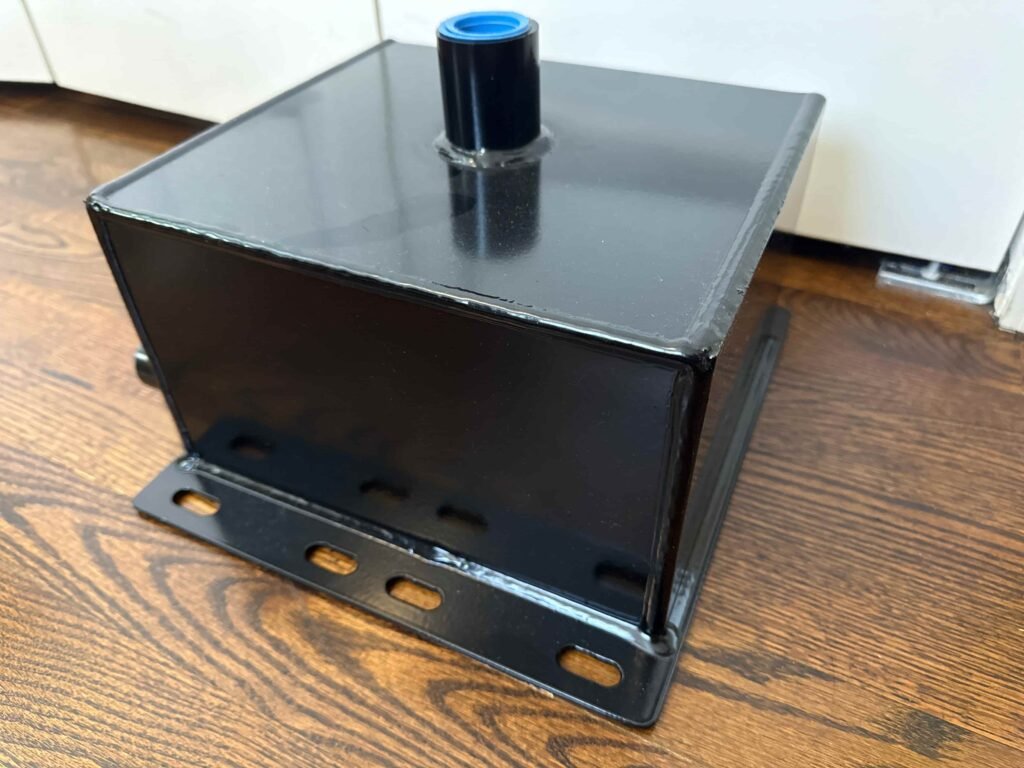
Where small hydraulic reservoir tanks actually fail
On a small hydraulic oil reservoir tank, the margin for error is thin. We see the same issues over and over:
Cracks starting at mounting tabs
Welds tearing around suction bungs
Pumps cavitating on startup
Oil overheating even with a cooler installed
Breathers pushing oil out after short run times
Most of these problems trace back to tank construction and layout, not the pump.
A 2–3 gallon tank lives in a harsher environment than most larger reservoirs. It’s usually frame-mounted, close to the power unit, and sees constant vibration. If wall thickness, weld sequence, or port placement is off, it shows up fast.
How we build 2–3 gallon hydraulic reservoir tanks
Steel and aluminum choices
Most of our 2 gallon hydraulic reservoir tanks are built from 12–14 gauge steel. Thinner material saves weight but doesn’t last on mobile equipment. Aluminum can work, but only when mounting and weld prep are handled correctly. Poorly supported aluminum tanks fatigue early.
If weight matters, we’ll talk through the tradeoff before cutting metal.
Welding and threaded ports
Threaded ports are where small tanks usually fail first.
We:
Machine or source proper steel bungs
Control heat input so threads don’t distort
Fully weld around ports, not stitch
Pressure check finished tanks
A distorted suction port doesn’t leak — it just slowly kills the pump.
Internal layout in a small volume
You don’t have room for bad decisions inside a small hydraulic reservoir tank.
We pay attention to:
Return oil entry away from suction
Oil dwell time, even in 2–3 gallons
Baffle placement that actually fits the tank
Over-baffling a small tank can restrict flow just as easily as no baffle at all.
Mounting causes more failures than tank size
Most replacement jobs we see involve tanks that were hard-mounted to vibrating frames.
When a hydraulic reservoir tank is rigidly mounted with no isolation, it becomes a stress member. That’s when cracks show up at corners and weld toes.
We design mounting based on:
Vertical vs horizontal orientation
Frame flex and vibration
Service access for drains and breathers
Hose routing and clearance
Sometimes the fix isn’t thicker steel — it’s changing how the tank is mounted.
Common applications for 2–3 gallon tanks
These small hydraulic reservoir tanks typically go on:
Compact hydraulic power units
Scissor lifts and small lifts
Dump trailers
Log splitters
Mobile skids
Utility and agricultural equipment
If the original tank already cracked or overheated, a direct replacement without changes usually fails again.
Stock vs replacement hydraulic reservoir tanks
If a standard catalog hydraulic reservoir tank fits, runs cool, and survives vibration, there’s no reason to replace it with custom.
We usually build a replacement hydraulic reservoir tank when:
Port locations don’t line up
Mounting points cracked on the original tank
Clearance forces an odd shape
Oil temperature is marginal for the system
The tank has already failed once
Custom doesn’t always mean expensive. It usually means built for the application instead of adapted to it.
What we need to quote a 2–3 gallon hydraulic reservoir tank
You don’t need a perfect drawing.
We can work from:
Overall dimensions
Port sizes and locations
Photos of the existing or failed tank
Mounting style and orientation
Steel or aluminum preference
If you do have a drawing, we’ll review it and flag problems before fabrication — especially around mounting and port placement.
A quick check before ordering
If your system:
Runs continuously
Operates in high ambient heat
Lives on mobile equipment
Has long return lines
A 2 gallon hydraulic reservoir tank may be the minimum, not the ideal. In some cases, adding volume or changing orientation prevents long-term problems.
We’ll tell you that before building anything.
Request a quote or send your drawing
If you’re replacing a failed tank or speccing a new build, send what you have. We’ll look at it the same way we do our own installs — focusing on what survives in the field, not what looks good on paper.